
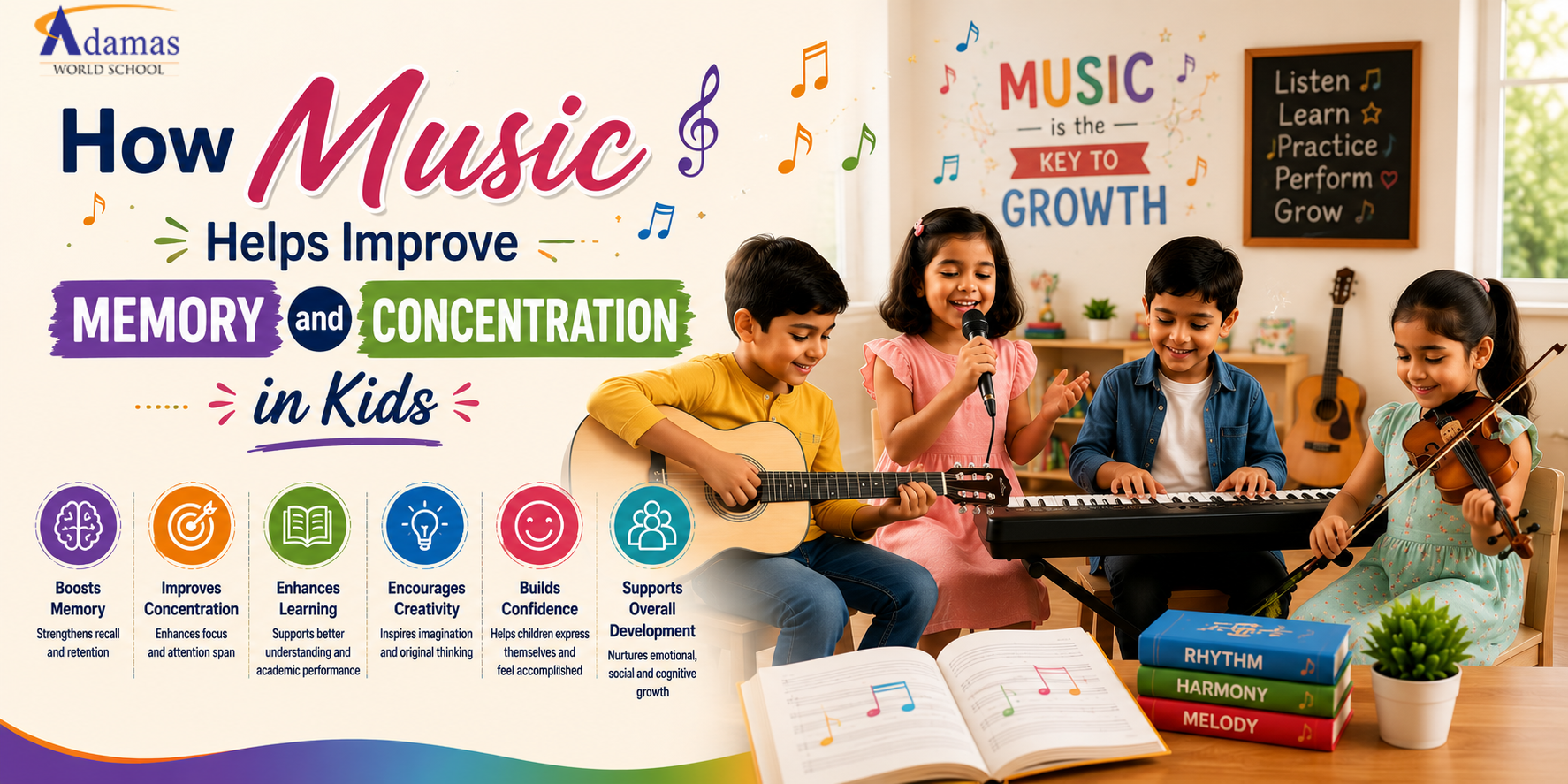
Music does measurable work on a young brain. Children who take part in regular musical activity, whether singing, rhythm games or learning an instrument, score higher on memory and attention tests than children who don’t, and the effect shows up strongest when training starts in preschool. One longitudinal study of primary school children found that the music group recalled about 20% more words from a list than the non-music group after 18 months of instrumental lessons. This blog breaks down why that happens and how a good preschool curriculum puts music to work.
Key Takeaways
- Music training strengthens verbal and working memory, the systems children use to hold and use information
- Effects appear even in preschool-aged children after regular, structured musical activity
- Rhythm and singing games double as concentration practice, since children must listen, wait and respond in sequence
- Music belongs inside the daily timetable in early childhood education, with the annual function as a bonus, never the whole programme
- Passive listening helps less than active music-making. Children need to clap, sing and play, with hearing alone doing little
What music does inside a child’s brain
Learning a song is a memory workout in disguise. A child holding a rhyme in their head must store the words, the tune and the order, then produce all three together. That juggling act runs on working memory, the same system used for mental maths and following multi-step instructions.
The research backs this up. A one-year study of 123 school children in China found that children given music training improved significantly more on digit span memory tasks than children given language training or none at all. And in research on preschool-aged children, working memory improved after 18 months of musical training, while an active control group showed no such gain.
Concentration grows the same way. A rhythm circle asks a 4-year-old to listen for their turn, hold back until it arrives, then respond on cue. Do that daily, and you are training the exact attention muscles a classroom demands.
How does a preschool use music to build memory?
Through structured preschool learning activities where music carries the content. Rhymes teach vocabulary and sequence. Clapping games teach patterns, the raw material of early maths. Action songs pair words with movement, which locks language into memory faster than words alone. Circle-time singing builds turn-taking and sustained attention. None of it looks like studying to the child. All of it is.
A few specifics worth knowing:
- Counting songs, rehearse the number order until it becomes automatic
- Call-and-response rhymes train listening and recall in one loop
- Instrument corners with shakers and drums build motor control alongside rhythm
- Songs in multiple languages stretch phonological awareness, the skill on which reading is built
Passive listening vs active music-making
Playing rhymes on a screen is not music education. The difference matters:
Aspect | Active music-making | Passive listening |
Memory demand | Child stores and reproduces words, tunes, sequence | Minimal, the child only receives |
Attention training | Must wait for cues and respond in time | None required |
Motor development | Clapping, actions, and instruments engage the body | Absent |
Social skill | Group singing means turn-taking and coordination | Solitary |
What research measures | Memory and attention gains after sustained training | Weak or short-lived effects |
Benefits beyond memory
- Language growth. Songs expose children to more vocabulary and clearer sound patterns than everyday conversation.
- Emotional regulation. Slow songs calm a restless group, and children learn to match their energy to the music.
- Confidence. A shy 4-year-old who sings with 20 classmates performs without realising it.
- School readiness. Following musical instructions is rehearsal for following classroom instructions.
Where music programmes fall short
Music helps only when it’s done regularly and done right, and a caveat belongs here. The strongest studies measured children with sustained training over a year or more, so one music period a month produces nothing measurable. Screen-based rhyme time is the most common shortcut, and it trades away nearly every benefit listed above. And forcing formal instrument lessons on a 3-year-old before their motor skills are ready builds frustration, not focus. The gains come from playful, frequent, teacher-led musical activity matched to the child’s age.
How parents can build music into the day: step-by-step
- Sing daily, badly is fine. A parent’s off-key rhyme beats a perfect recording, because the child joins in.
- Add actions to songs. Movement plus words doubles the memory hook.
- Play stop-and-go games. Dance when the music plays, freeze when it stops. This is concentration training dressed as fun.
- Give simple instruments. A steel dabba and a spoon count. Rhythm matters, equipment doesn’t.
- Ask the school what music looks like weekly. During admission visits, ask how often children make music rather than only hearing it.
Early childhood education tips for musical homes
- Repeat the same songs for weeks. Repetition is the point; boredom is the adult’s problem, not the child’s.
- Use songs for transitions at home: a clean-up song, a brushing song. It cuts battles and builds sequencing.
- Watch what your child hums. Recall without prompting means the memory circuits are firing.
Music every day at a preschool built for it
At Adamas World School in Barasat, Kolkata, music runs through the pre-school programme daily rather than appearing once a term. Rhymes, rhythm play and movement sessions sit inside the timetable for Toddlers through UKG, and the school’s co-curricular activities give older children stage time through music and dance performances at events across the 110-acre campus. For families in North 24 Parganas looking at preschool options, it’s the kind of daily, active music exposure this research points to.
Conclusion
A child who sings, claps and plays rhythm games every day is running memory and concentration drills without knowing it, and the research shows those gains carry into reading, maths and classroom behaviour. If you want your child’s early childhood education to include real, daily music-making, visit Adamas World School’s pre-primary wing in Barasat and watch a session in action. Admissions for 2026-27 are open; you can apply online, and the admissions team is available on +91 84799 18043 for any questions about the programme or campus. Few things you choose at age 3 keep paying off at age 13 the way music does.
F.A.Q (Frequently Asked question)
From birth, informally, through lullabies and rhymes. Structured group music in early childhood education works well from age 2.5 to 3, when children can follow simple cues. Formal instrument lessons suit most children only from the age of 5 or 6 onwards.
Indirectly, yes. Music training strengthens verbal memory, attention and phonological awareness, which feed reading and mathematics. Studies show musically trained children learning up to 20% more in word recall tasks. It supports academics rather than replacing study.
Both. Daily rhymes and rhythm games belong inside the core preschool curriculum, while performance opportunities like annual shows sit in co-curricular activities in preschool. A school that treats music as a once-a-year event is leaving most of the benefit on the table.
Rhythm instruments first: shakers, hand drums, tambourines, and even a steel dabba with a spoon. They need no technique, so the child works purely on rhythm and listening. Melodic instruments like keyboard or violin suit most children from age 5 or 6, once finger control and patience catch up.
It supports speech development well, since songs slow language down, repeat sounds and pair words with rhythm, which helps children produce them. Music complements professional support rather than replacing it, so a child with a suspected delay should still see a speech therapist alongside daily singing at home.
Recorded music playing in the background is fine, and screen rhyme videos are best kept brief for preschoolers. The working rule: recordings are seasoning, live singing and playing are the meal. If the child watches a rhyme, sing it together afterwards without the screen.