
For most of India’s history, school officially started at six, in Class 1. Everything before it, the nursery rhymes, the first wobbly letters, the first morning away from mum- counted for nothing on paper. NEP 2020 tore that up. And the fact that the government bothered tells you how much those early years actually decide.
Under the new setup, the three pre-primary years plus Classes 1 and 2 got bundled into one “Foundational Stage,” part of formal schooling for the first time ever. The logic is blunt: a child who starts on solid ground doesn’t hit the potholes later that a shaky start digs. Pre-primary isn’t a warm-up act before the real show. It’s the stage the whole show gets built on.
Here’s what this guide covers, what pre-primary actually gives a young child, how the stages fit together, and why the play-based route beats drilling the alphabet into a three-year-old every single time.
Key takeaways
NEP 2020 made pre-primary part of the formal “Foundational Stage” (ages 3 to 8) for the first time, under the 5+3+3+4 structure.
Pre-primary covers Playgroup, Nursery, LKG and UKG, building communication, early literacy, numeracy and social skills through play.
The approach is play-based and experiential by design, deliberately replacing rote learning at this age.
Children who attend a good pre-school move into Class 1 more smoothly, join in more, and hit fewer gaps later on.
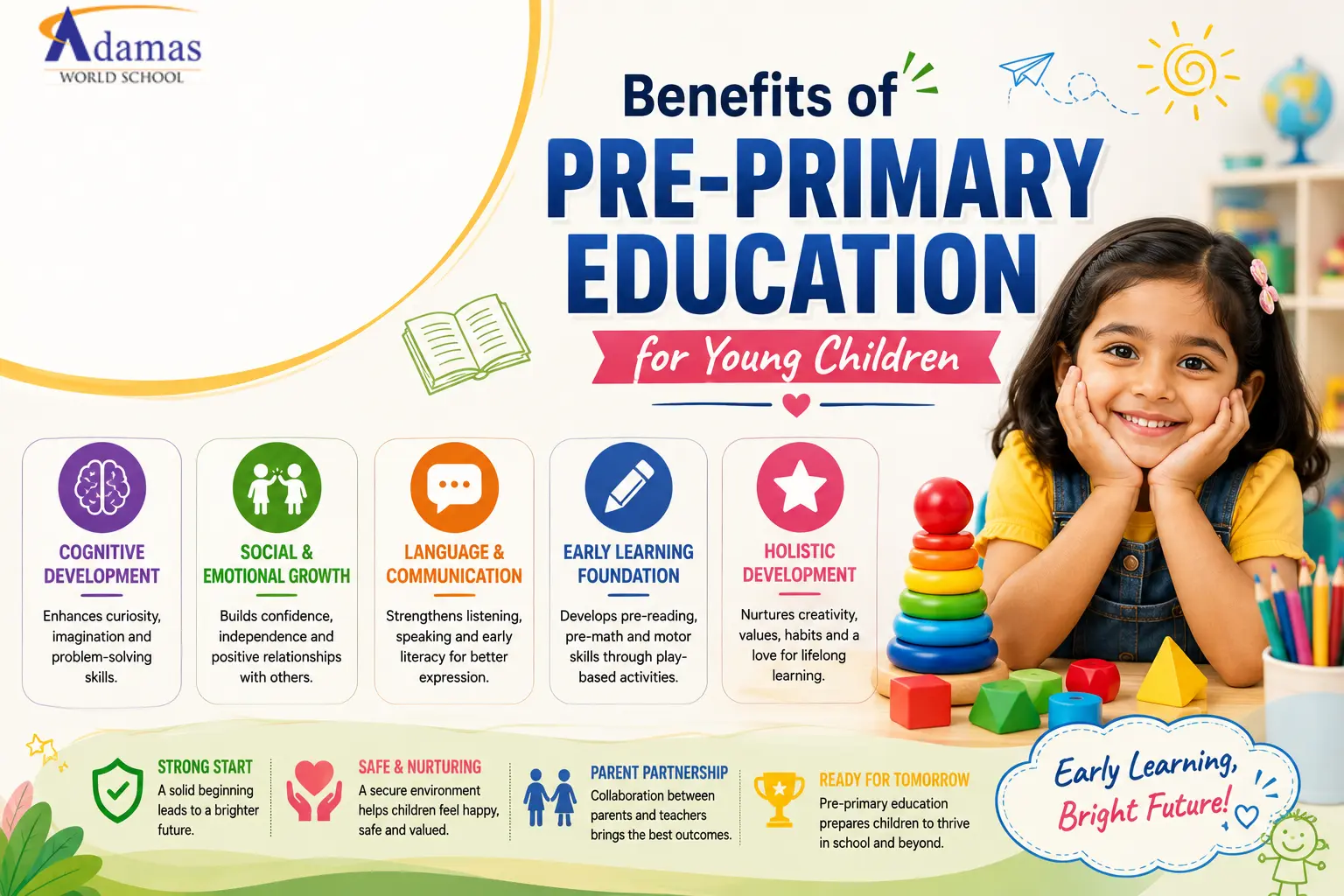
The gains are cognitive, social, emotional and physical at once, the whole child, not just early academics.
Why pre-primary suddenly became a national priority
The shift here is bigger than most parents clock, and it reframes what these years are for.
Before NEP 2020, kids aged 3 to 6 sat outside the education structure completely. Class 1 kicked off at six, and everything before was informal, unregulated, take-it-or-leave-it. The new policy folds three years of Early Childhood Care and Education, plus Classes 1 and 2, into a five-year Foundational Stage, and sets a target: quality pre-primary for every child heading into Grade 1, no later than 2030.
The evidence behind that call is heavy. Study after study links strong early years to lasting gains:
Better school performance further up.
Lower dropout rates.
Sharper cognitive skills that show up years later.
And, down the line, better work and life outcomes.
A child who starts with a solid base tends to skip the learning deficits that pile up and compound as the grades climb. Get the foundation right, as UNICEF puts it, and the payoff runs for decades.
The stages of pre-primary, and what each one does
“Pre-primary” isn’t one thing; it’s a sequence, and each rung has a job. Under the ECCE framework it looks like this:
| Stage | Age (approx.) | What it’s for |
|---|---|---|
| Playgroup | Under 3 | First steps in being around other kids, basic communication |
| Nursery | 3-4 | Foundational cognitive skills, letters and numbers introduced gently |
| Lower KG (LKG) | 4-5 | Pre-reading and pre-writing skills |
| Upper KG (UKG) | 5-6 | Early reading, writing and arithmetic, Class 1 prep |
Each rung leans on the one below it, so a child climbs toward formal school by degrees instead of getting dropped into it cold. This is also the line between a play school and a structured pre-primary: a play school is mostly about socialising, while pre-primary runs a planned, developmental curriculum underneath the fun.
Learning through play, not pressure
This is the part NEP got right, and it cuts against a common parental instinct, so it’s worth saying plainly.
At this age, kids learn best when they’re allowed to be kids. The policy openly backs play-based, activity-led, experiential learning, drawing on Montessori, Froebel and India’s own reformers, and deliberately walks away from the rote drilling that used to sneak into early classrooms. A joyful room does more real good here than a pressured one.
Which doesn’t mean nothing’s being taught. When a four-year-old plays with a purpose, they’re stacking up vocabulary, phonemic awareness, early number sense and problem-solving, they’re just doing it the way small brains actually absorb things. A pre-primary that drills three-year-olds on handwriting is fighting the grain. One that teaches through stories, blocks and guided play is working with it.
The benefits, across every domain
A good pre-primary grows the whole child, and the gains cluster into four areas that feed each other:
Cognitive and language. Vocabulary, early literacy and phonemic awareness through storytelling and language-rich play, plus early numeracy and problem-solving, the roots the rest of school grows from.
Social. Sharing, waiting a turn, listening to a teacher, working next to other children. The exact skills that make Class 1 survivable, and hard to build at home alone.
Emotional. Safe spaces where a child learns to name a feeling and handle it, the start of real emotional regulation.
Physical. Fine motor skills (holding, threading, stacking) and gross motor skills through active play, in spaces built for it.
The aim right through is holistic development, not just alphabet recognition. The good programmes grow all four together instead of trading the rest for early academics.
How pre-primary sets up school readiness
The most practical benefit, the one parents feel first, is how much smoother the move into real school becomes.
A child who’s been through a structured pre-primary walks into Class 1 already knowing the things that otherwise flatten a new student:
Sitting in a group without wandering off.
Listening to a teacher and following an instruction.
Separating from a parent without a meltdown.
Working alongside other kids.
They settle faster and join in more. NEP’s Foundational Literacy and Numeracy goal sits right here too, every child reading, writing and doing basic maths by Class 3. Strong pre-primary years are what put that within reach, because a child arriving at Class 1 with the groundwork laid isn’t scrambling to catch up from day one.
Pre-primary education at Adamas World School, Kolkata
None of these benefits show up unless the school delivers them the way NEP intends, play-based, developmentally right, with trained early-years teachers instead of early academic pressure. That’s the thing to hunt for, and it’s exactly where schools split. Adamas World School, part of the Adamas group in Kolkata, follows the CBSE curriculum and runs its pre-primary inside a campus that carries on to the senior years, so a child’s foundation connects straight to what follows rather than needing a fresh start somewhere else.
Choosing a pre-school? The questions worth asking are the same everywhere:
Is the approach genuinely play-based, or dressed-up drilling?
Are the early-years teachers trained for this specific age?
Does the room feel joyful, or pressured?
The admissions team can show you how it runs on the ground.
The bottom line
Pre-primary education isn’t the optional prelude it once got treated as; NEP 2020 made it the formal foundation of a child’s entire schooling, and the research is what put it there. Done properly, through play rather than pressure, it builds the cognitive, social, emotional and physical groundwork that makes Class 1 and everything after it manageable. Pick a pre-school for its play-based approach and its teachers over its academic promises, and you’re handing your child the strong start the whole system is now built around.
Looking for a pre-school in Kolkata that gets the early years right? Apply to Adamas World School, or call the admissions team to see the pre-primary section and how it readies children
FAQs
What is the right age for pre-primary education?
Roughly three to five, moving through Playgroup (under 3), Nursery (3-4), then LKG and UKG (up to 5), before Class 1 lands at six. Under NEP 2020 these years are now formal schooling. The exact starting age wobbles a bit by school policy, but honestly, whether the child is ready and whether the place is any good matter more than a precise cutoff.
Is pre-primary school different from a play school?
Yes, and the gap is real. A play school is mostly about settling a child among other kids and letting them socialise. A pre-primary runs an actual curriculum underneath, teachers plan the lessons, use visual tools, build cognitive and early-literacy skills in a deliberate order. Both have their place, but pre-primary is the more structured step toward Class 1.
Does pre-primary education actually help later on?
More than parents expect. The research keeps linking quality early education to better school results, lower dropout rates and stronger long-term outcomes. Kids who attend slide into Class 1 more smoothly and dodge the gaps a shaky start creates. NEP’s whole Foundational Stage rests on one idea, get the base right and the deficits never pile up.
Should pre-primary lean on academics or play?
Play, and it’s not close. At this age children learn through doing, playing, exploring, and NEP deliberately steers away from rote drilling here. Purposeful play builds vocabulary, early numbers and problem-solving the way young brains genuinely work. A pre-school pushing formal academics on three-year-olds is fighting how they develop, and usually denting their confidence in the bargain.
What exactly is the NEP Foundational Stage?
It’s the first block of NEP 2020’s 5+3+3+4 structure, covering ages 3 to 8: three years of pre-primary (ECCE) followed by Classes 1 and 2. For the first time, kids aged 3 to 6 sit inside India’s formal education structure rather than outside it. The stage runs on play-based learning and aims for Foundational Literacy and Numeracy by Class 3.