
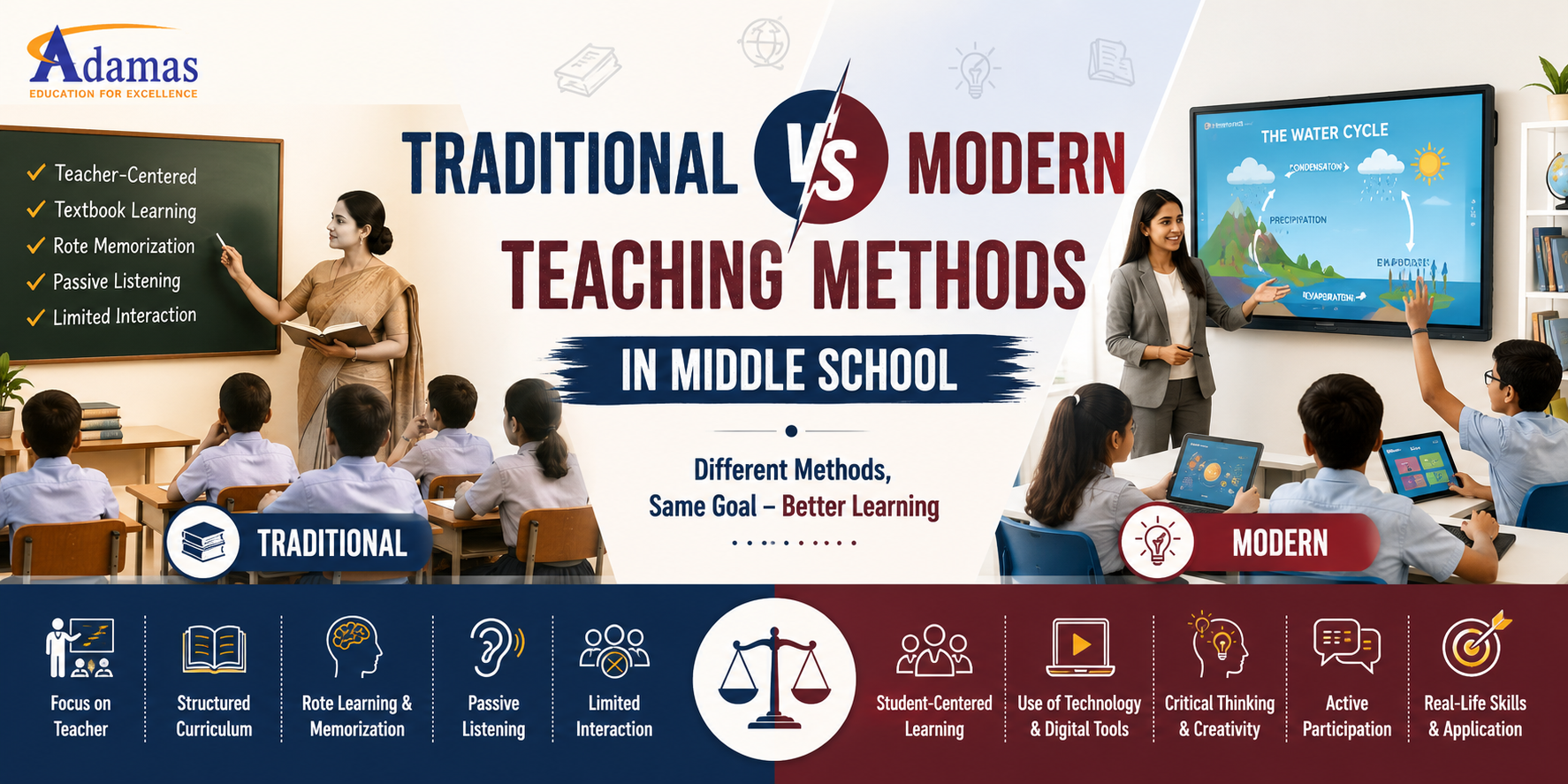
Neither pure lecture nor pure activity wins. The strongest middle school education for Classes VI to VIII blends both: traditional methods for building the knowledge base, modern methods for making it stick and mean something. The evidence leans one way, though. A meta-analysis of 225 studies published in PNAS found students in traditional lecture-only classes were 1.5 times more likely to fail than students taught through active learning, whose exam scores ran about 6% higher. This post compares the two approaches honestly, including where the old ways still beat the new.
Key Takeaways
- Traditional methods (lecture, textbook, drill) build foundations fast but struggle with retention and application
- Modern methods (projects, discussion, experiments) deepen understanding but need more time and skilled teachers
- NEP 2020 explicitly moves the Middle Stage (Classes 6-8) toward experiential and discovery-based learning
- Ages 11 to 14 are when abstract thinking develops, making this the stage where method matters most
- The schools getting the best results run a blend, not a side
Why Class VI to VIII is where teaching method matters most
Middle school sits at a cognitive turning point. Around ages 11 to 14, children move from concrete thinking into abstract reasoning. They can suddenly handle algebra’s unknowns, history’s cause-and-effect chains, science’s invisible forces. A method that just delivers facts wastes this window. A method that makes students wrestle with ideas uses it.
India’s education policy recognises this. Under NEP 2020’s 5+3+3+4 structure, Classes 6 to 8 form the Middle Stage, built around experiential and discovery-based learning, with vocational exposure and coding entering the curriculum. The lecture-and-memorise model that defined Indian middle schools for decades is officially on its way out.
But “officially” and “on the ground” differ from classroom to classroom. That gap is what parents should evaluate.
How the two methods compare
Aspect | Traditional methods | Modern methods |
Core mode | The teacher explains, students listen and take notes | Students do discuss, build, and present |
Coverage speed | Fast, syllabus finishes on time | Slower, depth over breadth |
Retention | Weaker, memorised facts fade | Stronger, applied knowledge stays |
Discipline and structure | High, clear routines | Varies, needs skilled management |
Exam preparation | Strong for recall-based papers | Strong for competency-based papers |
Cost to the school | Low | Higher needs labs, training, and smaller groups |
Student role | Receiver | Participant |
What traditional methods still do well
Writing off lectures entirely is fashionable and wrong. Direct instruction remains the fastest way to introduce new material, and middle schoolers need a knowledge base before they can “discover” anything with it. A student can’t debate the causes of 1857 without first being told what happened in 1857.
Traditional strengths worth keeping:
- Structured practice. Maths fluency comes from solving many problems, and drill builds the automaticity that problem-solving rides on.
- Clear routines. Predictable classes suit the age group’s need for structure.
- Teacher expertise front and centre. A great explainer compresses hours of confusion into minutes of clarity.
- Exam technique. Board exams still reward the writing discipline that traditional classrooms rehearse daily.
What modern methods add
Where lectures stop, modern methods start: at the moment, knowledge has to be used. Scott Freeman, the University of Washington researcher behind the PNAS meta-analysis, noted after the results came in: “The biggest surprise for us was the magnitude of the effect, especially on failure rates.” Students taught actively simply failed far less.
In a Class VI to VIII setting, modern practice looks like:
- Project-based learning. A month-long water audit of the school teaches more chemistry, geography and maths than three chapters read silently.
- Discussion and debate. Articulating a position is how understanding gets tested and fixed.
- Experiments before explanations. Seeing the result first makes the theory land.
- Technology as a tool. Simulations, coding basics and research tasks are used deliberately rather than as screen-time filler.
- Continuous assessment. Portfolios and presentations track student development across the whole term instead of loading everything onto exam day.
Where each approach fails
Both methods break when applied lazily. Traditional teaching fails quietly: students who can recite definitions but freeze when a question is worded differently, marks earned through memory alone that collapse in Class 9 when the syllabus outgrows rote. Modern teaching fails loudly: “activity classes” that are chaos with props, projects that parents complete at home, and discussion periods where three confident students talk and thirty stay silent.
The failure pattern is the same in both cases, a method without intent. A worksheet can be thoughtful. A group project can be empty. What matters is whether the teacher knows why each method sits where it does.
How parents can evaluate a school’s teaching approach: step-by-step
- Ask to observe a regular class, not a demo. Watch whether students speak, ask questions, or only take dictation.
- Look at student notebooks. Copied board work throughout suggests pure lecture. Rough work, diagrams and corrections suggest thinking.
- Ask how Classes 6-8 handle science practicals. Weekly lab time is a strong signal; “practicals start in Class 9” is a red flag under NEP.
- Check assessment styles. Schools following CBSE’s competency-based direction test application alongside recall.
- Ask what teacher training happens yearly. Modern methods live or die on trained teachers.
- Talk to a current middle schooler if you can. Ask what they built, argued or investigated this term. Silence answers the question.
Secondary school preparation tips for Class VI to VIII
- Don’t equate homework volume with rigour. Two thoughtful problems beat twenty copied ones at this age.
- A blend that shifts by subject is healthy: maths needs more drill, science more experiment, social science more debate.
- Secondary school preparation starts here, quietly. The study habits, note-making, and self-driven reading built in Classes 6-8 decide how Classes 9 and 10 feel.
A blended middle school built on the NEP model
The middle school programme at Adamas World School in Barasat, Kolkata, runs exactly this blend for Classes VI to VIII: structured CBSE academics alongside laboratory work, projects and co-curricular activities that put knowledge to use, with the 110-acre Adamas Knowledge City campus giving room for sports and hands-on learning that a lecture hall never could. Students then move into the school’s own secondary section, carrying the same approach forward, which is the continuity of middle school education in North 24 Parganas that it rarely offers.
Conclusion
The traditional vs modern debate has a boring, correct answer: the best middle schools refuse to choose. They lecture where lecturing is fastest, and they hand over the work where doing teaches more, all pointed at genuine student development rather than method for its own sake. If you’re weighing schools for Class VI to VIII around Barasat or Madhyamgram, visit Adamas World School and watch a middle school class in session. Admissions for 2026-27 are open through the online admission procedure, and the admissions team is on +91 84799 18043. The method your child learns under for these three years shapes every year after them.
FAQs (Frequently Asked Questions)
The blend does. Traditional practice builds the writing speed and recall board exams reward, while active methods build the conceptual grip that competency-based CBSE questions now target. Schools running only one mode leave marks on the table either way.
Only when it changes what students do. A smartboard used for the same old dictation is a traditional lecture with better lighting. Technology counts as a modern method when students use it to simulate, build, code or research something themselves.
Classes 9 onwards demand self-study, application and longer answers built from understanding. Students trained through projects, labs and discussion arrive with those muscles already working, while rote-trained students often hit a wall when the syllabus depth doubles.
The Middle Stage introduces a third language, vocational exposure through activities like coding and craft, and a shift toward experiential learning and competency-based assessment. Science and social science become distinct subjects, and schools are expected to reduce pure rote work in favour of application.
Sixty to ninety minutes a day is a reasonable band for Classes VI to VIII, provided it’s thinking work rather than copying. Volume beyond that usually signals a school outsourcing teaching to the home. Quality of tasks matters far more than the count of pages.
Ask about ideas, not marks: “What did you figure out today?” opens more than “How much did you score?” Protect reading time, limit passive screen hours, and let the child struggle with homework before helping. Independent problem-solving built now is the core of secondary school preparation.