
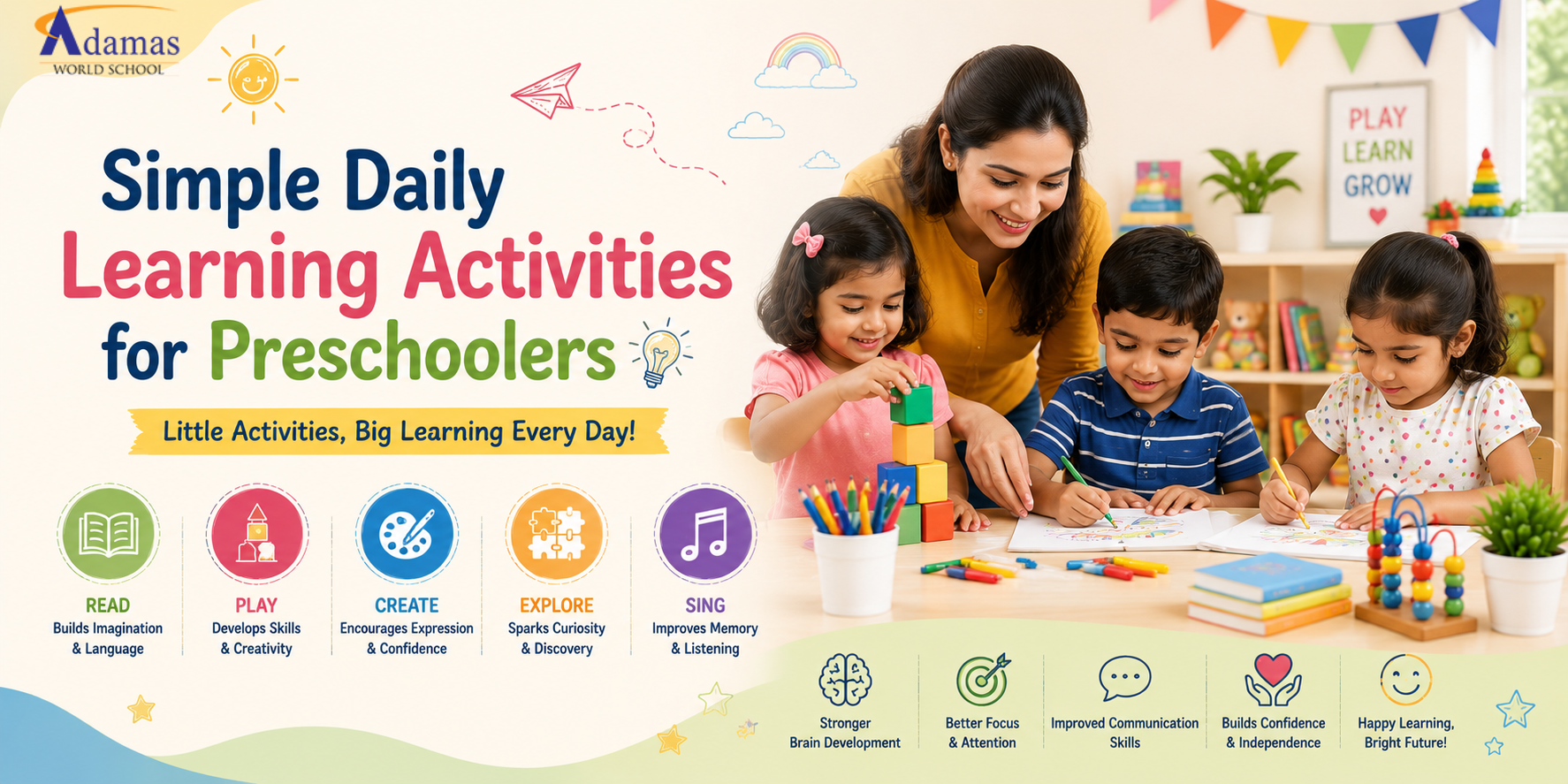
The best learning activities for preschoolers are the ones that fit into an ordinary day: reading one book aloud, counting dal into a bowl, naming colours on the way to the market. Done daily, these small habits do more for child development than any expensive kit. The numbers are striking. An Ohio State University study found that children who read just one book a day hear about 290,000 more words by age 5 than children who aren’t read to, and five books a day pushes that gap to 1.4 million words. Those words become the vocabulary a child walks into primary school with. Here is a full week’s worth of activities that cost nothing.
Key Takeaways
- Ten minutes of daily reading aloud is the single highest-return activity for a preschooler
- Household chores double as learning: sorting laundry teaches categories, laying plates teaches counting
- Talking through the day builds vocabulary faster than flashcards ever will
- Consistency beats intensity. One short activity daily outworks a two-hour weekend session
- These habits directly shape readiness for primary education, from pencil grip to sitting tolerance
Why small daily activities matter so much
A preschooler’s brain is forming more than a million neural connections every second, according to Harvard’s Centre on the Developing Child, and everyday experiences decide which connections strengthen. Repetition is the mechanism. The child who counts steps on the staircase every evening isn’t doing maths once; they’re wiring number sense permanently.
Jessica Logan, who led the Ohio State reading study, put the payoff plainly: “Kids who hear more vocabulary words are going to be better prepared to see those words in print when they enter school.” The same logic runs through every activity below. Daily exposure now, easier learning later.
Which daily activities build which skills?
Match the activity to the skill and the day plans themselves:
Daily activity | Skill it builds | Time needed |
Reading one storybook aloud | Vocabulary, listening, print awareness | 10–15 min |
Sorting objects (spoons, socks, blocks) | Categorisation, early maths logic | 5 min |
Counting real things (fruits, stairs, buttons) | Number sense | Built into routine |
Drawing and scribbling freely | Pencil grip, pre-writing motor control | 15 min |
Helping with one small chore | Sequencing, responsibility, motor skills | 10 min |
“What did we do today?” conversation | Memory recall, sentence building | 5 min at bedtime |
Benefits parents see within weeks
- A bigger speaking vocabulary within weeks. Children start using words from books in their own sentences.
- Longer sitting tolerance. Storytime and drawing stretch attention span gradually, which every primary school classroom demands.
- Independence. A child who pours their own water and packs their own bag needs less handholding at 6.
- Smoother school transitions. Teachers can tell within a week which children have daily routines at home.
- A closer parent-child bond. Fifteen minutes of undivided attention daily changes behaviour more than any correction does.
Where parents go wrong with home activities
Good intentions can misfire, and three mistakes come up constantly:
- Turning play into a test. “What colour is this? No, say it properly,” kills the fun that drives the learning. Follow the child’s interest instead of quizzing.
- Outsourcing everything to apps. Screen-based learning games hold attention but skip the conversation, movement and hands-on manipulation that this age depends on.
- Doing too much at once. Buying five workbooks and scheduling an hour of “study time” burns out a 4-year-old in a week. Small and daily wins.
One more honest note: daily activities at home support school, they don’t replace it. A structured preschool adds peer interaction, trained observation and group routines that no home setup can produce alone.
A simple daily routine: step-by-step
- Morning: narrate the routine. Talk through brushing, dressing, and breakfast. Constant language exposure costs nothing.
- One task with you. Let the child pour, stir, sort or carry something during household work.
- Afternoon: free drawing or blocks. Unstructured creation time, no instructions.
- Evening: outdoor play. Running, climbing, and ball games build the gross motor base that writing later sits on.
- One book before bed. Same book on repeat is fine. Repetition is how preschoolers learn.
- Two-minute recap. Ask “What was the best part of today?” and let them build the sentences.
Child development tips before primary school admission
- Keep a low shelf of 8-10 books the child can reach alone. Ownership drives interest.
- Rotate toys instead of adding more. Three available toys get deeper play than thirty.
- Praise effort, not cleverness. “You kept trying” builds more persistence than “you’re so smart.”
- During primary school admission interactions, schools look for exactly what these routines build: listening, responding, and basic self-help. No coaching needed if the daily habits exist.
Where daily habits meet structured learning
The home routines above work best alongside a school built for this age group. At Adamas World School in Barasat, the pre-school wing runs on the same principle: short, hands-on, play-based activities that build language, number sense and motor skills through the day, moving children smoothly into its own primary school on the same campus. For families across North 24 Parganas, Madhyamgram and Barasat, comparing options for primary education, that continuity from Toddlers to Class 12 removes the admission scramble most parents face at age 5.
Conclusion
Ten minutes of reading, a chore done together, numbers counted on the staircase. None of it looks like education, and all of it is the education that matters at this age. Start with one book tonight and build from there. And when you’re ready to pair those home habits with the right classroom, visit Adamas World School’s campus in Barasat to see how its pre-primary and primary sections carry the same approach forward. Primary school admission enquiries for 2026-27 are open, the admission procedure is online, and the team is reachable on +91 84799 18043. Strong child development is built one ordinary day at a time, and the days start now.
FAQs (Frequently Asked Question)
Thirty to forty-five minutes total, broken into small pieces across the day. A preschooler’s focused attention runs 10-15 minutes at best, so short daily bursts beat long sessions. Reading aloud is the one non-negotiable if you must pick a single activity.
Yes, better than coaching does. Schools assessing children for Class 1 look at language, number familiarity, motor skills and the ability to follow instructions. Daily reading, counting and chores build all four naturally, without the stress that drilling creates.
Sparingly, from age 4.5 onwards, and never as the main activity. Hands-on play builds the finger strength and cognitive base that worksheets assume. A child who threads beads and draws freely will manage worksheets easily later. The reverse isn’t true.
Six years for Class 1, as per NEP 2020, which CBSE schools now follow with a cut-off date, commonly 31 March of the admission year. Working backwards, that places Nursery entry at age 3, which is why starting these daily activities early matters.
Look for these markers: follows two or three-step instructions, sits with an activity for 10-15 minutes, communicates needs in sentences, manages basic self-help like eating and toileting, and separates from parents without prolonged distress. The daily activities in this post build every one of these.
Anything with a wait built in: board games with turns, freeze dance, cooking steps done together, and read-alouds where the child must listen before the page turns. Concentration grows through practice at holding attention, and games disguise the practice as fun.